Electrolysis as Core Technology
Electrolysis is the cornerstone of sustainable Power-to-X, converting renewable electricity into green hydrogen, synthetic fuels and chemicals. Our work advances high and low temperature electrolysis to enable efficient, scalable, and durable energy conversion for the energy transition.
In the low-temperature path, the low temperature CO2 electrolysis will be further developed and scaled up to higher cell areas. Various test rigs will be built-up for testing at different cell sizes and to generate statistically relevant data considering the requirements of data acquisition for machine learning and model parametrization. Parallel testing of cells over longer time is planned. A highly integrated, CCM or MEA-based CO₂-to-CO electrolysis cell with optimized geometry and materials, enabled by model-driven design, precise component integration, and structured process development to achieve high efficiency, stability, and scalability, with close coupling between cell design, manufacturing, and experimental validation is targeted. Gas diffusion electrodes will be further developed. Furthermore, the CO2 electroreduction to formic acid will be further developed and scaled up. The third technology in focus is the coupled synthesis of Cl2 from Chloride and CO from CO2 using low-temperature co-electrolysis.
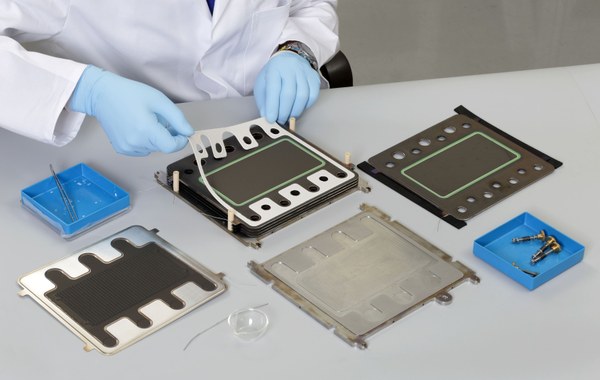
The research activities on the high-temperature path put the fuel electrode supported solid oxide cell (SOC) technology in focus, which can be used as electrolysis, fuel cells and a combination of both in reversible operation. Both steam and co-electrolysis are in the focus of the development. Based on the existing SOC technology, reliable and efficient bi-functional cells and stacks in terms of performance and stability are tested and further developed in PHOENIX. Based on an innovative approach for substrates, new cells are developed which promise higher mechanical and thermal strength. In parallel, methods are being developed to significantly improve the interconnect metal properties critical to SOC applications by pretreating stack components made from conventional ferritic steels. The newly developed cells with improved substrates will be examined from a mechanical and thermal perspective to ensure their reliability before starting with electrochemical characterization. The electrochemical cell characterization also serves to deliver information for operation under various conditions for Power-to-X value chains. The electrochemical stack characterization focuses on the performance and stability characterization of the newly developed stack technology using advanced online-diagnosis processes. The findings from cell and stack testing are coupled with CFD and FEM modeling for the development of a new, light-weight stack technology for high-temperature electrolysis. The design addresses a stack design at low manufacturing costs, using less expensive steels and thin sheets, which open the way for industrialization and transfer of the newly developed stack technology in PHOENIX.