Funded by the Federal Ministry of Research, Technology and Space, the PHOENIX Project aims to transform the Rhineland mining region into a model area for sustainable industrial processes. The project will offer approaches to replace fossil-based value chains with innovative Power-to-X (P2X) technologies, laying the foundation for climate-neutral, future-proof jobs in key sectors such as chemicals, energy and plant engineering, and driving sustainable structural transformation.
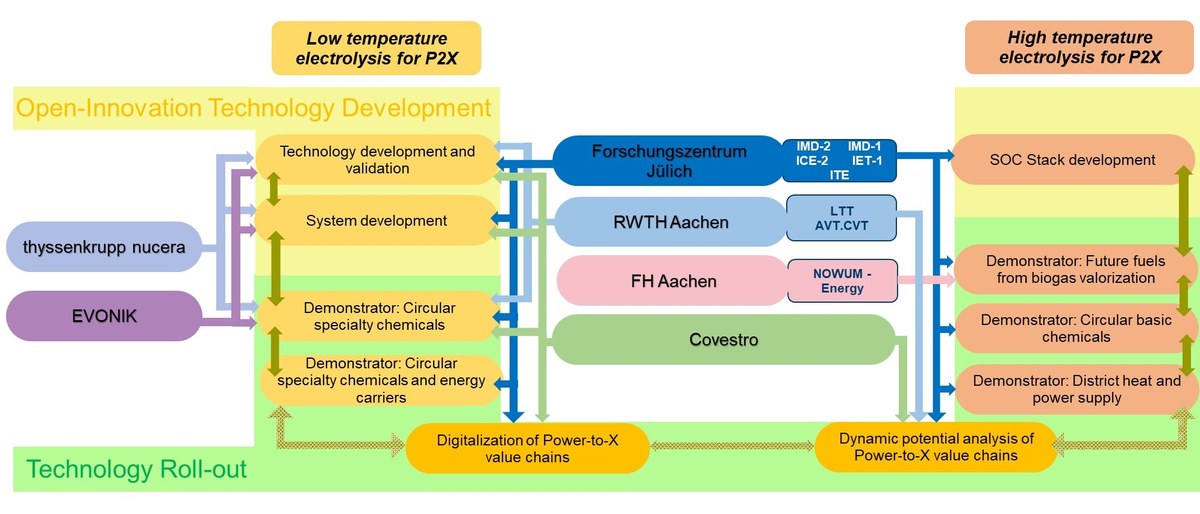
The project is structured using a matrix approach. On the Open-Innovation Technology Development Platform, both low-temperature and high-temperature electrolysis technologies are further developed. Research into low-temperature electrolysis focuses on developing and validating CO₂ to CO electrolysis and CO₂ electroreduction to formic acid, followed by system development. Research activities on high-temperature electrolysis focus on advancing solid oxide cell technology further, at material, cell, interconnector and stack operational levels. This will ultimately lead to a new lightweight stack design for the purpose of transferring and industrializing the developed stack technology, which is based on fuel electrode-supported cells. Technology roll-out is advanced by developing and operating five demonstrators on selected Power-to-X value chains. These aim to defossilize and/or decarbonize various sectors, offering excellent opportunities for technology transfer to regional industries through direct collaboration and coupling with upstream and downstream processes. The development of the demonstrators is accompanied by the digitalization of Power-to-X value chains, as well as their dynamic potential analysis.