Power-to-X Value Chains

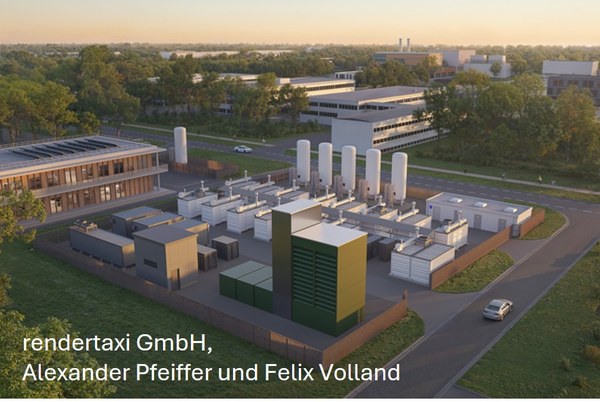
As part of the PHOENIX project, five Power-to-X value chains in the most promising application areas will be established and operated as mini-plant facilities in a launch space on the Forschungszentrum Jülich campus.
These demonstrators target possible Power-to-X application areas that could benefit the Rhineland region. Grid-integrated operation of electrolyzers under transient loads in market-, system-, or grid-optimized operating modes is of key importance. The development of these value chains is supported by simulating transient operating conditions using digital twins.
A central prerequisite for the widespread deployment of Power-to-X technologies in the Rhineland region is a comprehensive assessment of value chain potential. PHOENIX uses a combined "bottom-up" and "top-down" approach to identify how Power-to-X can be strategically applied and explore the creation of novel, cross-sectoral value chains. After selecting promising application cases, a bottom-up analysis evaluates their implementation across technical, economic, ecological, and social dimensions using life cycle assessments. Concurrently, a top-down analysis situates large-scale deployment within long-term regional transformation strategies aligned with national and European frameworks. Furthermore, a customized software framework is developed to model and assess decarbonization pathways through scenario analysis, enabling system-wide evaluation. From this macro perspective, the need for local Power-to-X networks and alliances is derived. In close collaboration with technology developers, additional relevant application cases are identified and analyzed in a second iteration. Macroeconomic assessments evaluate the potential impacts on the labor market and value creation. Finally, all results are synthesized into a holistic evaluation that provides a strategic foundation for the sustainable transformation of the Rhineland.
- A demonstrator for the de-fossilization of the fuel sector through biogas valorization (Future Fuels), which builds on the reversible operation of solid oxide cell technology. It considers the entire process chain, from various biogenic substrates derived from marginal soils and industrial waste, to biogas production, to a reversible co-electrolysis system that produces green fuels or electricity on demand for a sustainable mobility sector. In this process, biogas serves as a CO₂ source for co-electrolysis and as fuel for fuel cell operation.
- A demonstrator for the de-fossilization of the chemical sector for basic chemicals (Circular Base Chemicals) focuses on using non-avoidable industrial point sources of CO₂ and industrial wastewater. It utilizes high-temperature co-electrolysis to produce various base chemicals, such as methanol. The focus is on co-electrolysis operation and mitigating the risk of carbon formation.
- Demonstrator for Decarbonization of District Heat and Electricity Supplies. The third value chain aims to provide a flexible energy conversion system to decarbonize district heating and power supplies. It uses reversible solid oxide cell technology that operates on hydrogen in fuel cell mode and steam in electrolysis mode.
- The demonstrator for the de-fossilization of the chemical sector for specialty chemicals follows a two-path approach to produce circular specialty chemicals. The first value chain combines low-temperature CO₂ electrolysis with thermal catalytic processes to produce green specialty chemicals. The demonstrator's focus is the power-to-CO value chain based on AEM technology. The second path considers the coupled synthesis of Cl₂ and CO from chloride and CO₂ in low-temperature co-electrolysis.
- Demonstrator for De-fossilization of the Chemical Sector for Specialty Chemicals and Energy Carriers. The fifth value chain is based on CO₂ electrosynthesis to produce formic acid for the creation of "green" chemicals and energy sources. The main objective of this PHOENIX demonstrator is to produce a highly concentrated end product at a low cost, thereby enhancing its competitiveness as a sustainable alternative to conventional, fossil-based products.